The Visible Scalp You're Seeing Isn't Normal Aging—It's Perimenopause. Here's What 30,000+ Women Are Doing About It.
Most women try biotin, volumizing shampoo, and minoxidil before they understand what's actually happening. Here's the one thing that finally worked for 30,000+ women.
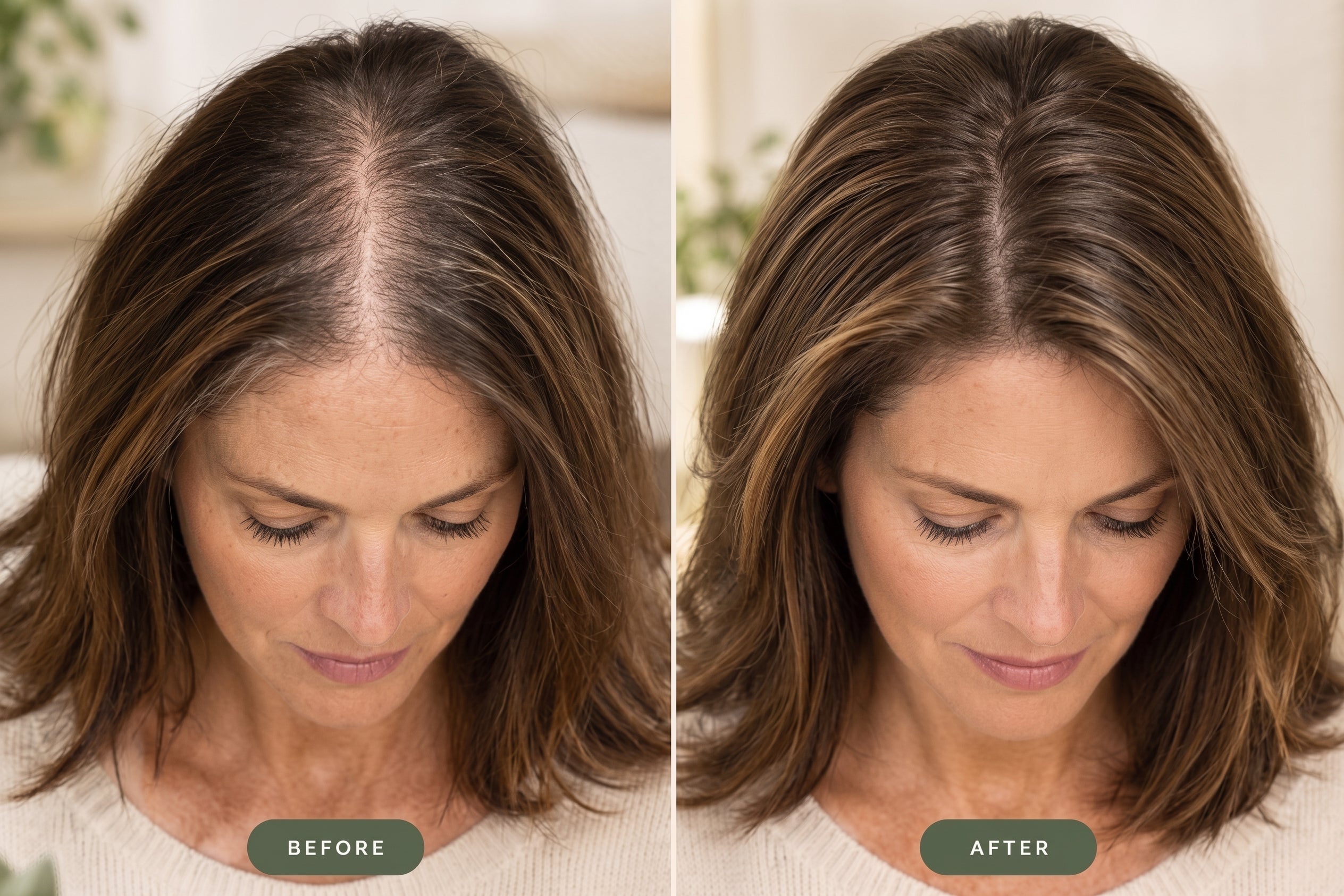
I Didn't Lose My Hair Overnight. I Lost It Little By Little.
Honestly? My hair had always just... been there.
I'd had thick hair my whole life. The kind women in salons used to comment on. The kind that took forever to dry. I never thought about it — which is, I realize now, exactly the point. I didn't think about it because I didn't have to.
Then, somewhere around 47, I started noticing things.
My part looked wider. Not dramatically — just enough that I'd catch it under bright bathroom lighting and stop. My ponytail, the one my sister used to call "unfairly thick," slipped right through a hair tie that used to snap holding it in place. I started finding more hair in the shower. More on my brush. A little more on my pillow.
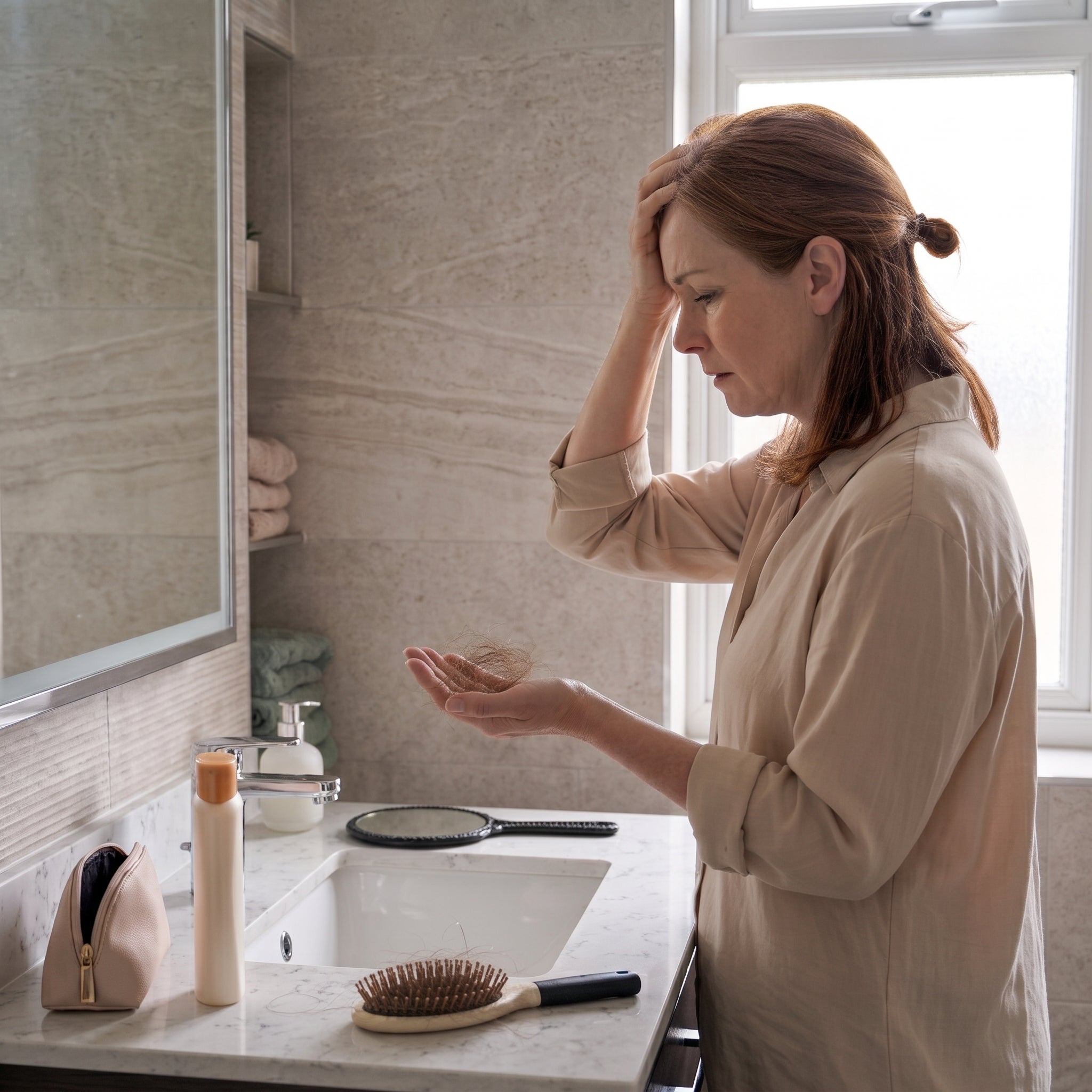
I told myself it was stress. Then I told myself it was my shampoo. Then I bought new shampoo. Then I bought a supplement. Then I bought another supplement.
For two years, I was buying solutions to a problem I didn't actually understand yet.
My GP looked at my scalp for about eleven seconds.

"This is pretty normal for your age."
— What every woman in her 40s has heard at least once
I wasn't ready to accept that. So I asked for a referral to someone who specifically treats hair changes in women.
She was different. She didn't rush. She asked about my cycle. My sleep. When I'd first noticed the shedding. And then she asked something nobody had ever asked me before:
"When was your last period like clockwork?"
"Two years ago, maybe?"
She nodded, and explained that hormonal shifts during perimenopause are one of the most consistently overlooked contributors to hair changes in women my age. It rarely comes up in a standard appointment, she said. Most doctors don't connect the two.
I left that office doing math in my head. The shedding had started almost exactly when my cycle had become unpredictable. That wasn't a coincidence I'd ever connected before.
And for the first time, despite not yet having a solution, I felt something close to relief. Because I finally had an actual explanation — not just a shrug.
Hot Flashes Got All The Attention. Your Hair Got Ignored.
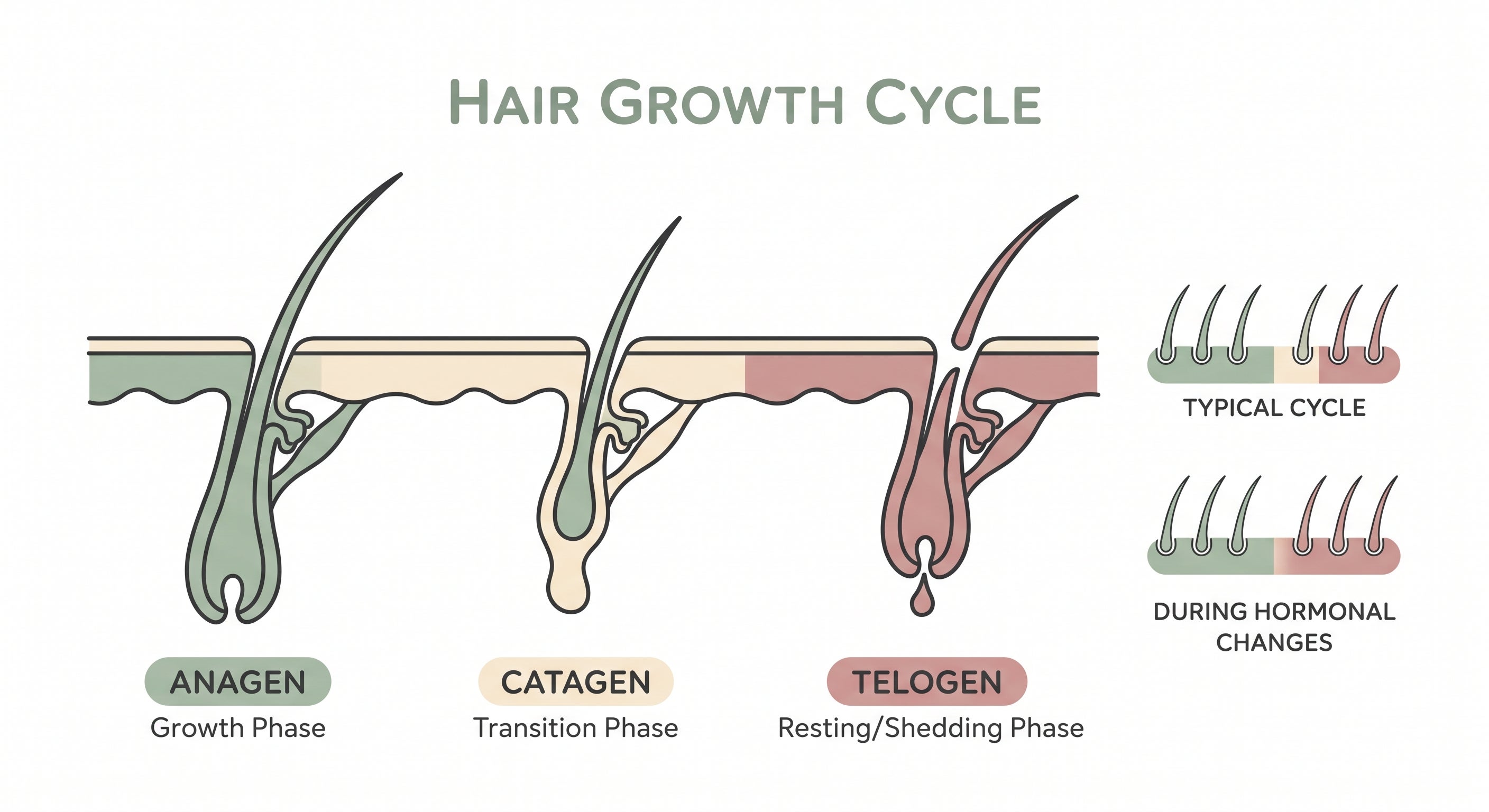
Like most women, I thought estrogen was mostly about periods, fertility, and eventually those hot flashes everyone warns you about. I had no idea it had been quietly supporting my hair for decades.
What estrogen had been doing behind the scenes:
As perimenopause begins and estrogen declines:
The result: the same part line. The same ponytail. The same mirror. But something looks different — and you can't explain why.
Once I understood why this was happening, I had one more question.
If estrogen had been quietly supporting my hair for thirty years... what could support it now?
See the scalp-focused routine I found for this stage of life.
See What I Found For This Stage Of Life →
I Wasn't Choosing the Wrong Products.
I Was Solving the Wrong Problem.
Here's what nobody tells you when you're standing in the hair care aisle at 46. Most of what's on that shelf wasn't formulated with this specific life stage in mind. Let me show you what I mean.
Supports keratin production — but true biotin deficiency is uncommon. For most women in perimenopause, adding more biotin doesn't address what's actually changed. You're treating a deficiency you probably don't have, while the real shift goes unaddressed.
Coats each strand to appear thicker for a few hours. It's cosmetic. It washes out completely. Your follicles don't know it existed. It's a daily illusion, not a solution.
There's real interest in rosemary's potential, and it may help support scalp circulation. But rubbing oil on your scalp once a day — while the underlying hormonal shift continues unchallenged — is like watering one plant in a garden that needs replanting. Helpful. Not sufficient.
The only FDA-approved topical hair treatment — and for some women, it genuinely works. But it's a drug, not a cosmetic. It requires twice-daily application, indefinitely. And for many women who stop, the progress reverses. It also does nothing to address the scalp environment or hair quality — just circulation. And the greasy, irritating texture pushes many women away before they see results.
These can support general hair health, and some women see real improvements in texture. But ingestible supplements take a long time, the evidence is mixed, and nothing about them speaks directly to the scalp during hormonal transition. Many women spend months on them and wonder if anything changed at all.
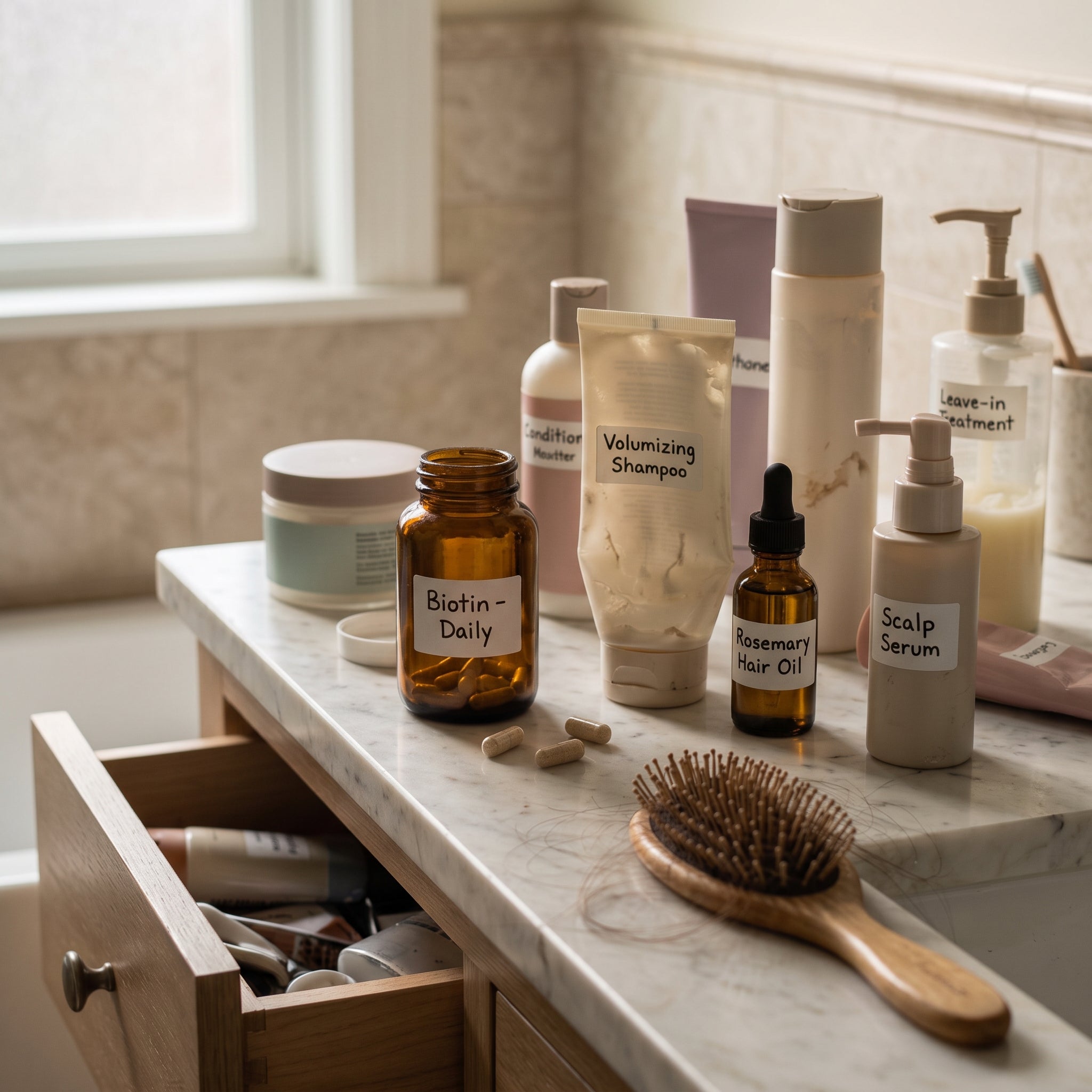
I stopped googling. I stopped buying. I stopped hoping something on a shelf would accidentally be the right thing. And then, almost by accident, I found something that looked genuinely different.
"The first product I found that actually acknowledged what was happening to my hair — instead of pretending it wasn't."
See What I Found →A Serum Built Around This Stage of Life. Not Despite It.
It's a peptide serum — but not in the vague, buzzwordy way most "peptide" products use that word. What convinced me wasn't the label. It was the logic.
Vellura doesn't try to change your hormones. Instead, it takes a different approach: daily scalp-focused care designed specifically around the visible changes so many women begin noticing around perimenopause. Rather than one isolated hero ingredient, it's a blend formulated to support the appearance of fuller, thicker-looking hair from multiple angles at once.
Here's what's in it, and why each piece matters:
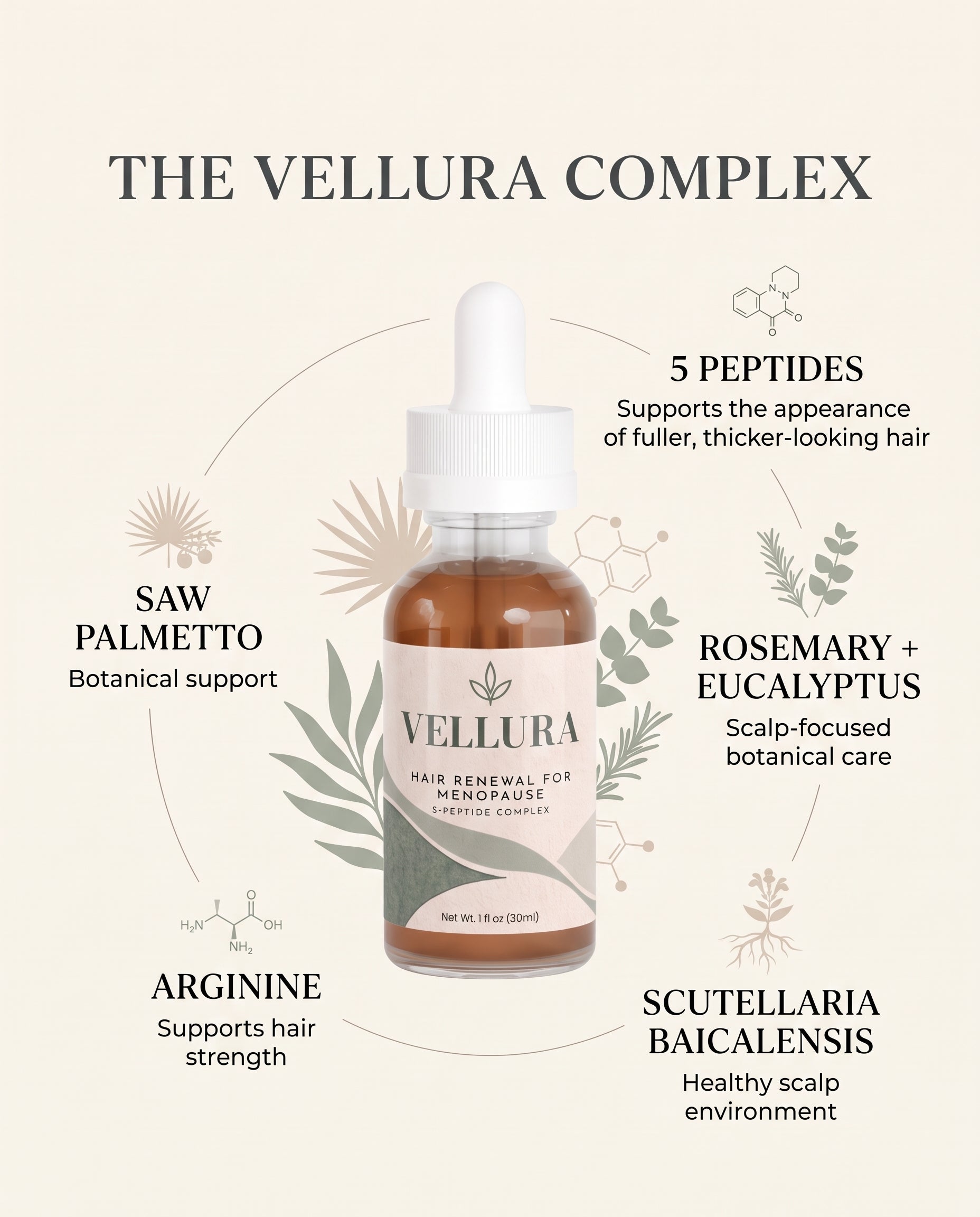
It's lightweight. Non-greasy. One step, not five products. And built to fit into a real morning routine — not demand that you build your life around it.
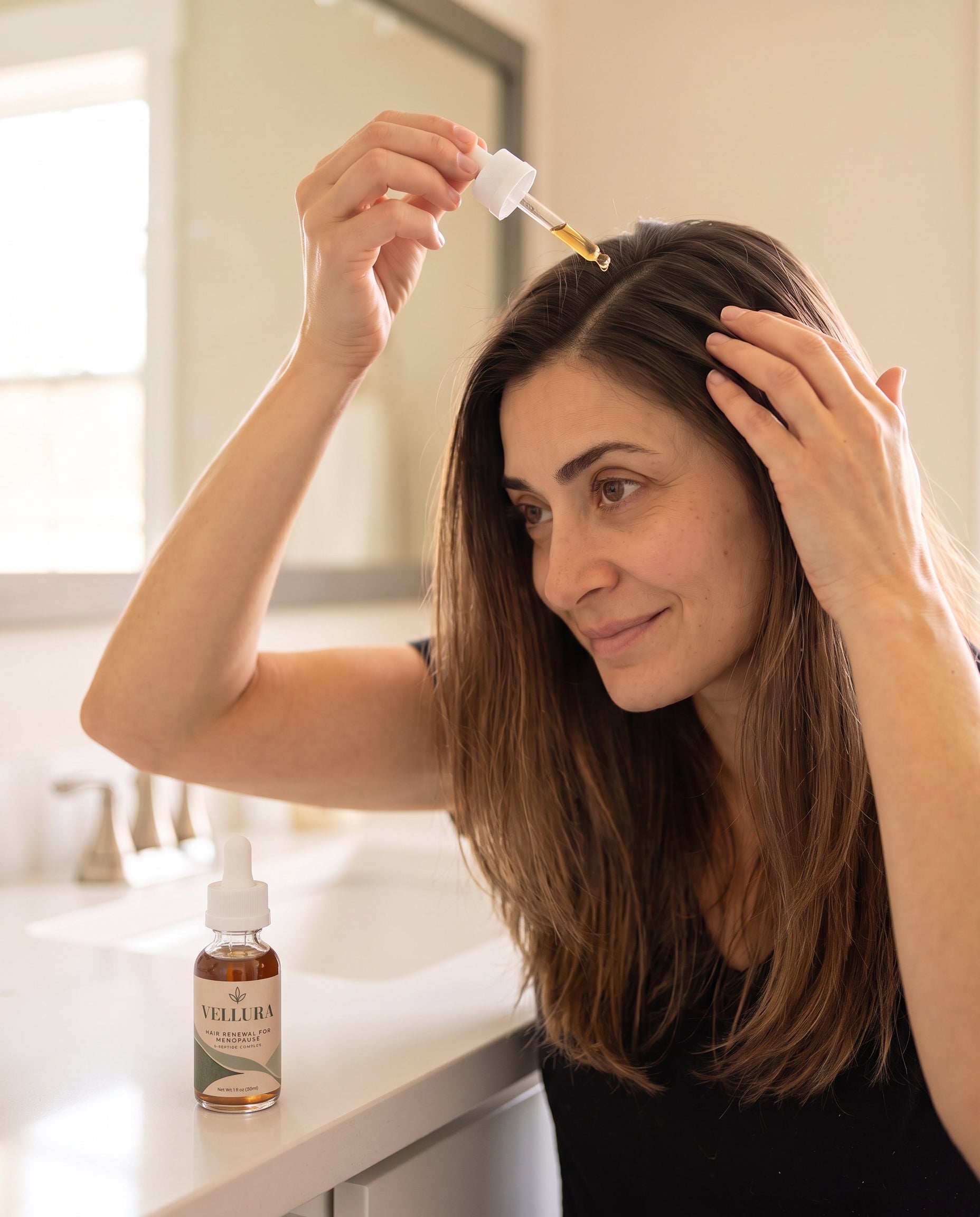
What struck me when I read through the formulation was simple: this was the first thing I'd found that was actually designed with this life stage in mind. Not designed for a 25-year-old with stress shedding. Not designed for postpartum regrowth. Designed for what happens to women's hair during perimenopause.
One simple daily step for your scalp. See how the Vellura routine works.
See How The Vellura Routine Works →Here's What My First Three Months Looked Like
Hair changes gradually — by nature. I'm sharing my timeline honestly, not as a guarantee. Results vary from person to person.
I committed to the daily routine. Nothing dramatic yet — and I wasn't expecting anything. But after years of reaching for products that promised overnight miracles, it was actually a relief to be using something that didn't make that promise.
I started paying attention in the shower. The amount of hair I was losing each wash — that number started looking more... manageable. My shower drain didn't look the way it had. I didn't want to get excited, but I noticed it.
I pulled up photos from three months earlier side by side. The part line looked different. My ponytail sat differently when I put my hair up. My stylist asked if I'd changed something. That was the moment I understood: it hadn't happened overnight, and it hadn't happened all at once. But it had happened.
I won't tell you it happened overnight, because it didn't. But it was the first routine that felt like it was actually built for this stage of my life — instead of built for someone else and hoped it would work for me.
Give your hair the time and consistency this stage deserves.
Start Your Vellura Routine →Turns Out, I Wasn't The Only One
Many women in the same stage of life describe similar experiences.
"My part looks wider than it used to."
You haven't changed where you part your hair. But somehow, more scalp seems visible than before — especially under bright bathroom lighting.
"My ponytail just feels... smaller."
Not necessarily falling out in handfuls. Just less hair than you're used to seeing when you pull it back. The hair tie that used to feel tight suddenly has room to spare.
"I've tried everything."
Biotin. Expensive shampoos. Oils. Supplements. Volumizing products. You keep trying something new, hoping this will finally be the thing that makes your hair feel like it used to.
"I don't want a miracle. I just want my hair to feel like mine again."
That's often the real frustration. The changes happen gradually — a little more scalp, a little less volume, a little thinner around the part — until one day you realize something has changed.
Questions I Had Before I Started
I've tried biotin, Rogaine, and expensive shampoos — and nothing worked. Why would this be different?
Because those weren't the wrong products — they were solving the wrong problem. Biotin addresses deficiency; most perimenopausal women don't have a biotin deficiency. Volumizing shampoos coat the strand cosmetically. Minoxidil is a vasodilator — it helps with circulation but doesn't address the scalp environment changing during hormonal transition.
Vellura's multi-peptide formula was designed specifically around the visible changes women experience during perimenopause — working at the scalp and follicle level, from several angles at once, rather than relying on a single ingredient doing a single job.
How long until I see a difference?
Hair changes gradually — that's just the biology of how follicles cycle. Most women notice something within 8–12 weeks of consistent daily use, though it often shows up first as less shedding before it shows as visible thickness. Results vary from person to person. You have 90 days to decide if it's right for you — completely risk-free.
Will it make my scalp feel greasy or heavy?
This was one of my biggest hesitations too, after years of minoxidil foam and heavy serums. Vellura is lightweight and absorbs quickly — it won't sit on your scalp or leave residue on your pillowcase. It's designed as a one-step daily routine you can actually stick with.
Do I have to use it forever?
That's a fair question, and an honest one deserves an honest answer. Your hair's environment continues to change during and after perimenopause. Consistent use gives the best results — like most care routines, it works best when you keep it up. Many women choose to continue because they notice the difference when they don't.
What if my doctor says it's "just aging" or "just genetics"?
You're allowed to want more than a shrug. Yes, genetics play a role. Yes, some hair thinning is part of hormonal aging. But that doesn't mean nothing can support the hair you have now and the scalp environment it grows from. Vellura isn't a cure — it's a cosmetic serum designed to support the appearance of fuller, thicker-looking hair at a stage of life that most products simply ignore.
I'm just starting perimenopause. Is this the right time?
Yes — and honestly, earlier is better. Hair changes during perimenopause are gradual. Supporting your scalp environment before significant thinning becomes visible is easier than trying to reverse it after. Many women who started Vellura early say they wished they'd known to look for something like this sooner.
Is it safe to use with other treatments?
Vellura is designed as a topical cosmetic scalp serum. If you're currently using a medicated hair-loss treatment or have a scalp condition, check with your healthcare professional before combining products.
If Any Part of This Sounds Like Your Story
You don't have to accept "this is just your hair now." You deserve a product that actually acknowledges what's happening — and was built for it.
Start My Vellura RoutineThese statements have not been evaluated by the Food and Drug Administration. This product is not intended to diagnose, treat, cure, or prevent any disease. Individual results may vary. Testimonials reflect individual experiences and are not a guarantee of results.